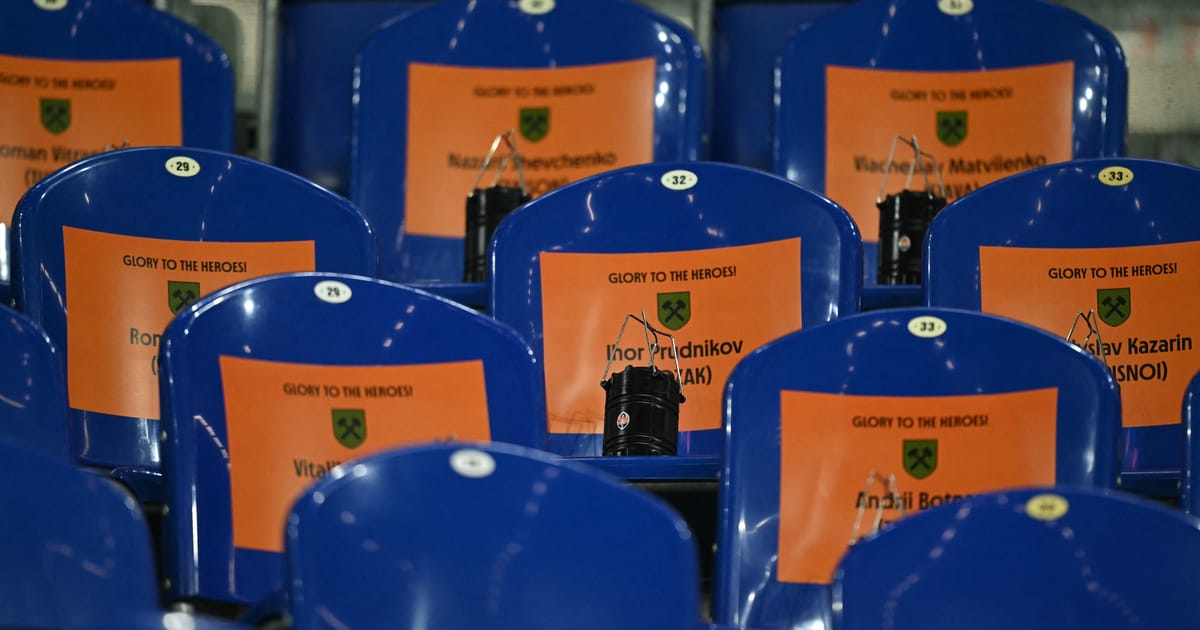
MONACO — Shakhtar Donetsk, Ukraine's top football team, will play its UEFA Champions League matches at Stamford Bridge, home of Chelsea FC, this week. Displaced from its home in Donetsk since 2014 due to Russian-backed aggression, the club aims to represent not only itself but the entire Ukrainian nation during this season's tournament.
Read More
In the marbled lobby of a Monaco hotel, Shakhtar's Chief Executive Sergei Palkin and Sporting Director Darijo Srna shared their perspectives on the team's efforts. Palkin emphasized that these matches carry significant emotional weight, as they aim to support Ukrainians who have relocated to places like London. “For us, it’s also to support Ukrainian people who left their homes,” he said.
Shakhtar’s journey mirrors Ukraine’s resilience amid ongoing conflict. Since being forced out of Donetsk nearly a decade ago, the team has played in various temporary cities while maintaining its competitive spirit. Following Russia's full-scale invasion in 2022, Shakhtar has held “home” games in Poland and Germany, and team officials are eager to play in England against opponents including AEK Athens and Real Madrid. “London is the capital of the football world,” Palkin remarked.
As they face immense challenges, Srna noted the desire to focus on playing football amidst ongoing stress back home. Both executives highlighted the need to convey Ukraine's message through sport.
Shakhtar’s uniforms feature the name of SCM, a prominent investment firm in Ukraine, owned by Rinat Akhmetov, the club's owner. The firm is advocating for Western investment in Ukraine as part of the nation’s reconstruction. SCM's Natalya Yemchenko stated that investments could provide strategic benefits for Europe as well.
Despite ongoing military and reconstruction financing challenges, Yemchenko stressed the importance of anti-corruption measures within SCM. She argued that maintaining Ukraine's economic strength is vital for European security. “Ukraine cannot keep defending Europe if its economy fails,” she stated.
Yemchenko underscored the impact of Russian attacks on Ukrainian infrastructure, noting that the goal is to create a humanitarian catastrophe and push people to abandon their cities. “This war is a Ukrainian war, but to a big extent, it’s a European war, unfortunately,” she concluded.