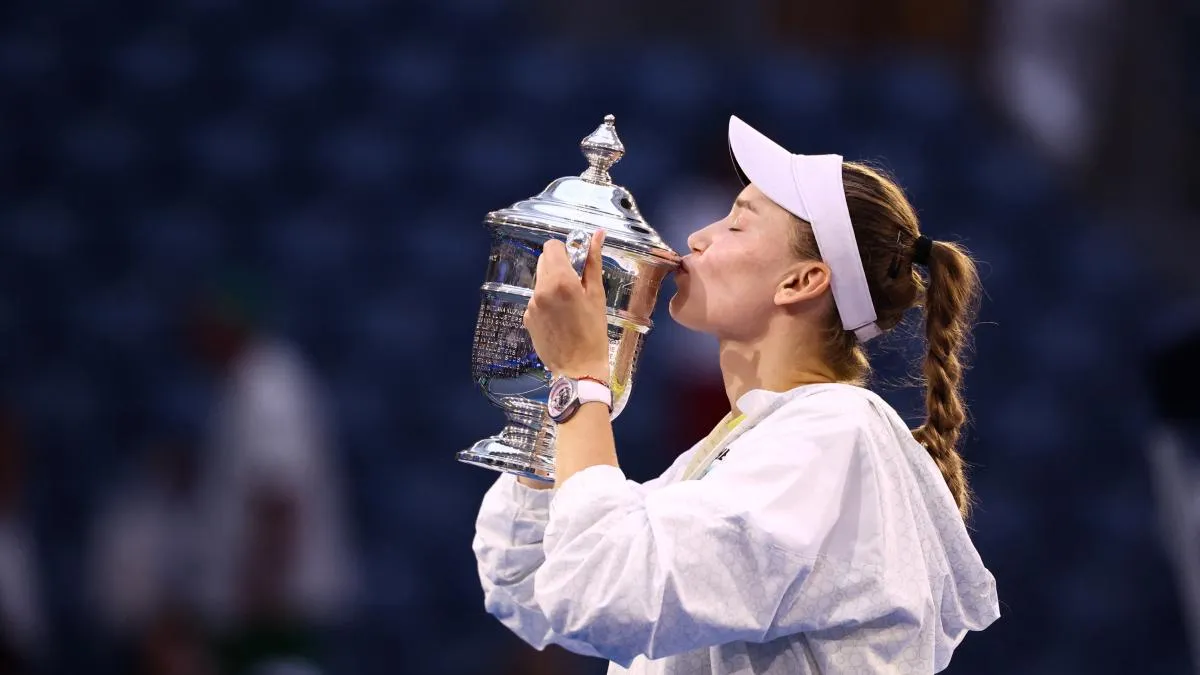
Elena Rybakina faced significant financial challenges early in her career, unlike many of her peers who received early brand support. According to Bulat Utemuratov, president of the Kazakhstan Tennis Federation, Rybakina's family was reaching their financial limits in Russia, prompting them to seek a more stable base for her tennis career.
Read More
Before taking Kazakh citizenship in 2018 at age 18, when she was ranked world No. 200, Rybakina struggled to secure sponsorships and often traveled to tournaments alone. Her family even considered the possibility of her leaving professional tennis for a university scholarship in Malibu. Rybakina’s father, Andrey, recounted receiving a bleak contract from the Russian federation that offered no financial support but urged them to persevere.
The switch to representing Kazakhstan proved pivotal for Rybakina. Utemuratov noted her professionalism, independence, and readiness to take control of her career as key factors in their decision to support her. Since then, she has rapidly ascended in the sport, breaking into the Top 100 in 2019, reaching the semifinals at the Tokyo Olympics in 2021, and winning Wimbledon in 2022 during a period when Russian players were banned from competition.
By 2023, Rybakina solidified her status as a leading player, reaching the Australian Open final and winning WTA 1000 titles at Indian Wells and Rome. By the end of the season, she added the WTA Finals title, becoming the Australian Open and US Open champion and achieving the world No. 1 ranking.
Utemuratov expressed that supporting Rybakina in 2018 was crucial not only for her career but also for the sport in Kazakhstan, marking a historic achievement.
However, Rybakina faced her share of challenges. In 2022, just before her Wimbledon victory, she contemplated quitting tennis amid frustrations over her performance. Following discussions with her family, she returned to training.
In early 2025, she navigated another hurdle when the WTA investigated her coach, Stefano Vukov, resulting in a provisional suspension. Despite the media scrutiny, Rybakina defended her coach, who continued to support her. After an independent tribunal found no basis for the suspension, she returned to form, demonstrating dominance in her matches and establishing a substantial lead over her closest competitor, Aryna Sabalenka.